Some major Trump donors are now reaping billions in ICE contracts
Trending News

Audio By Carbonatix
7:00 AM on Monday, April 6
By Emma Sullivan for OpenSecrets, Stacker

Some major Trump donors are now reaping billions in ICE contracts
Since returning to the White House in 2025, President Donald Trump has ramped up immigration detention, with private contractors operating much of the required infrastructure — and reaping hundreds of millions of dollars in Immigration and Customs Enforcement contracts after making significant contributions to the president’s political operations.
Federal contracting data shows that a small group of private prison operators, charter airlines and security contractors dominated ICE’s largest contracts in 2025. Two private prison companies, the GEO Group and CoreCivic received $2.1 billion and $653.5 million in total obligations, respectively, while charter aviation companies, including CSI Aviation ($1.1 billion) and Classic Air Charter ($800.2 million), also secured major contracts. Transportation contractor MVM Inc., which moves unaccompanied migrant children and families to detention facilities, received $1.1 billion, OpenSecrets reports.
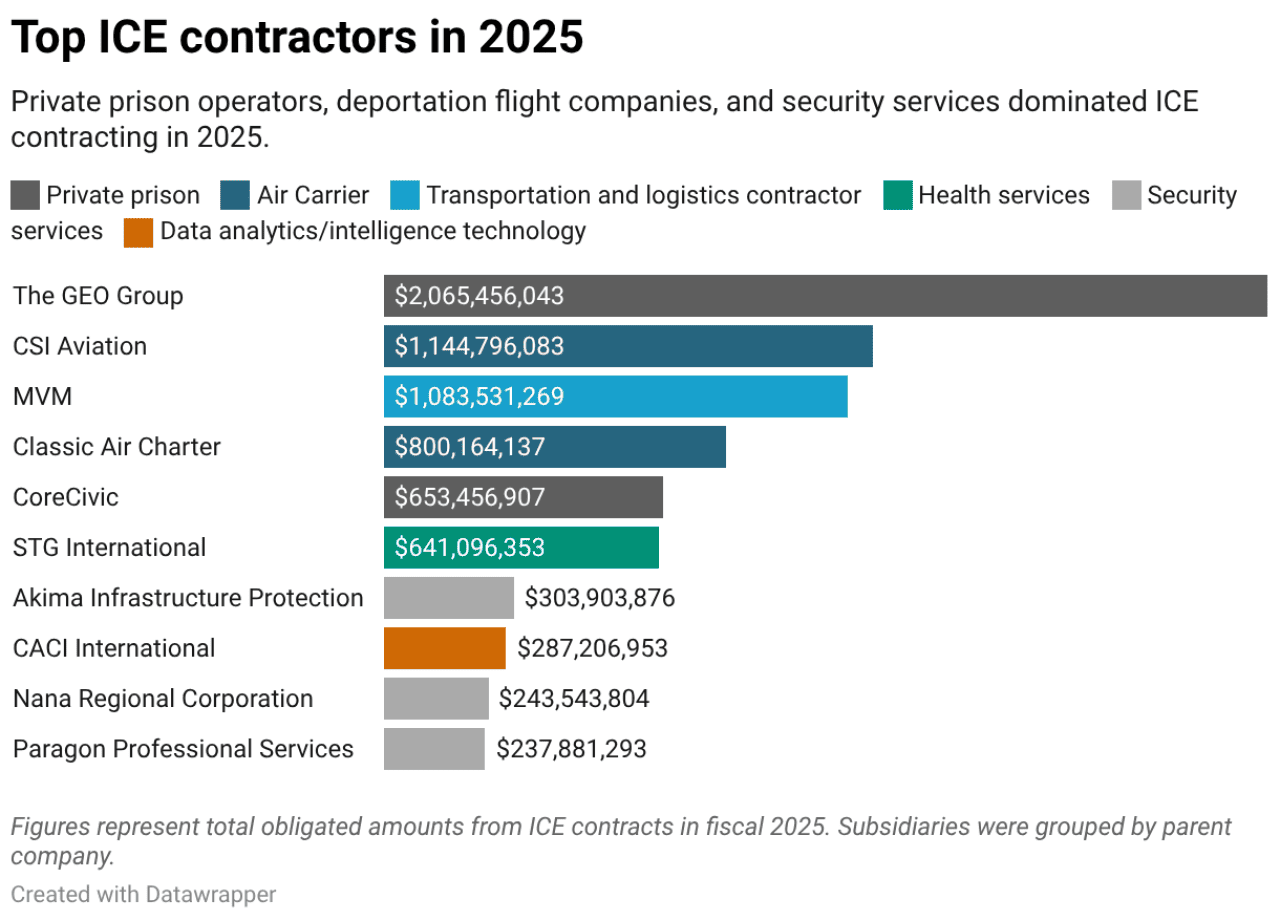
Several of those companies and their executives have contributed to committees affiliated with Trump, according to Federal Election Commission and OpenSecrets data.
In the first five months of fiscal 2026, CSI Aviation and GEO Group continue to dominate ICE contracting, each holding more than $1 billion in total obligated contracts.
Frank Baumgartner, a political scientist at the University of North Carolina at Chapel Hill, said many Americans are unaware of how much the agency spends on immigration enforcement — and how costly that system has become for taxpayers.
“From the perspective of the private companies, there’s profits to be made and huge contracts to be awarded with relatively little oversight, since they’re being given out so quickly,” Baumgartner said. “This is long-term spending, and it’s hundreds of billions of dollars, so it’s a little bit scary, if you ask me, as a taxpayer.”
Unprecedented reliance on private companies
While law enforcement agencies often outsource support services such as food preparation or clothing, ICE is “unusual” in its reliance on private contractors for far more central functions, said César Cuauhtémoc García Hernández, an Ohio State University professor of law who teaches about the intersection of criminal and immigration law.
“What we see when it comes to ICE is that everything from transportation to the ownership and operation of prison facilities themselves is typically done by a private company under contract with ICE,” García Hernández said.
Although the Justice Department operates the Justice Prisoner Air Transportation System, which provides long-distance deportation flights, ICE Air Operations primarily relies on private charter companies to transport migrants.
Under the Trump administration, ICE enforcement flights have surged. Between Jan. 20, 2025, and Jan. 20, 2026, ICE conducted 14,426 enforcement flights, an 89% increase from the year before, according to Human Right First’s ICE Flight Monitor, which tracks immigration enforcement flights using publicly available aviation data.
Although deportations increased 46%, rising from 1,544 removal flights during the final year of the Biden administration to 2,253 in 2025, the largest jump in immigration enforcement flights came from domestic transfers between detention facilities, which surged 132%, from 3,909 to 9,066 flights.
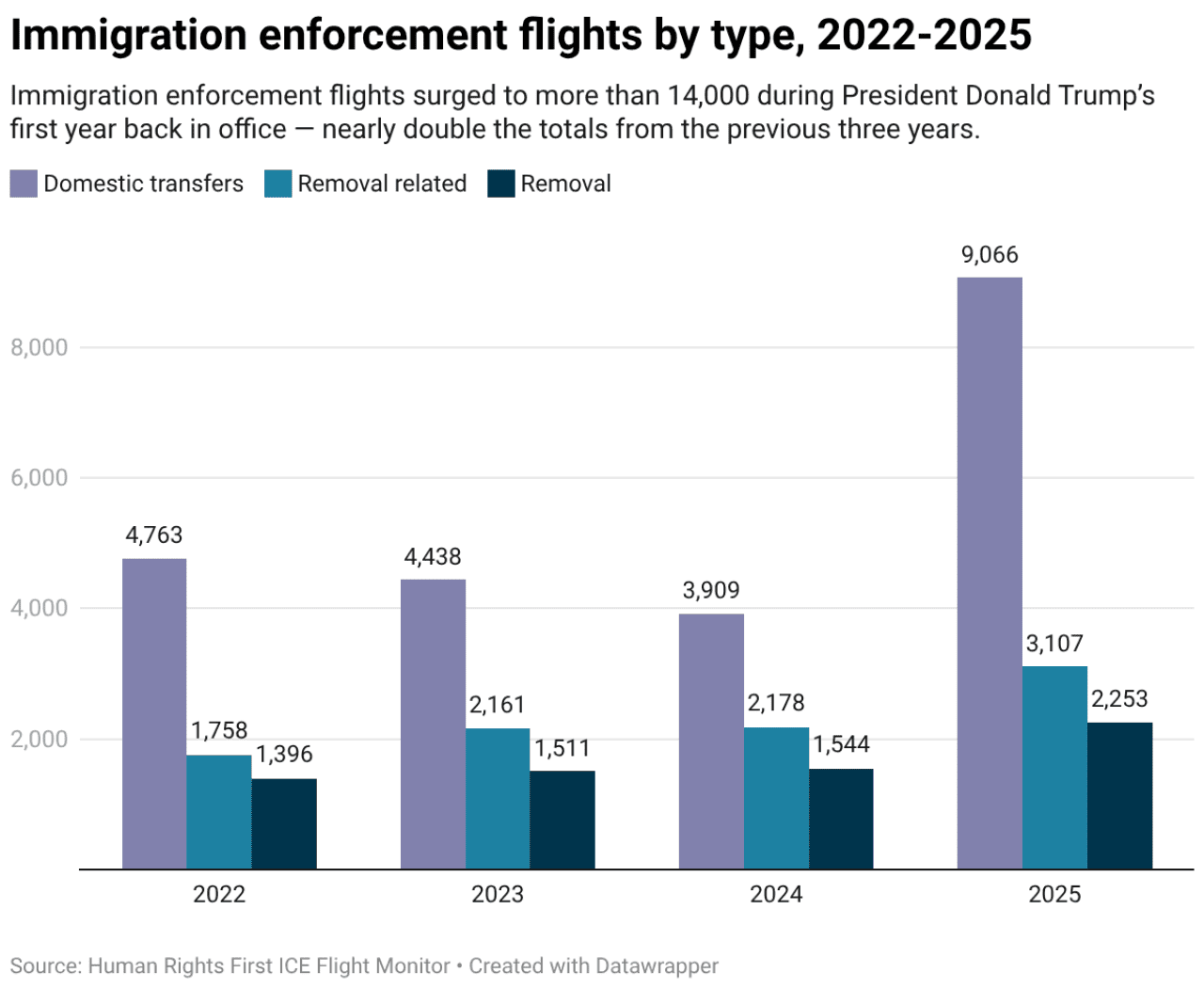
During that period, private charter airlines and transportation contractors received hundreds of millions of dollars in ICE contracts to operate deportation flights and move detainees between facilities. In 2025 alone, CSI Aviation received a $562 million contract to provide daily charter flights, including scheduled large aircraft and high-risk transport operations, while transportation contractor MVM Inc. received $145.1 million in new contracts to transport detainees.
Air carrier CSI Aviation has received the largest new ICE contract in fiscal 2026, with $673.4 million in obligations and a potential value of $1.5 billion, to provide dedicated and on-demand charter flights for enforcement and removal operations under the ICE Air program.
Tanya Golash-Boza, a professor of sociology at the University of California, Merced, said relying on private contractors allows immigration enforcement to expand more quickly than if those functions were carried out directly by the government.
Private prisons remain central to immigration detention
That reliance on private contractors is reflected in the detention system itself, where private companies house the vast majority of immigrants in ICE custody. Although private prisons account for a relatively small share of the overall U.S. incarcerated population, they play an outsized role in immigration detention. As of early 2025, about 86% of immigrant detainees were held in privately run facilities, compared with less than 10%of the overall U.S. incarcerated population, according to the Migration Policy Institute.
Immigration detention and monitoring have both increased sharply in recent months. ICE is currently detaining roughly 70,000 people across 225 jails and detention centers — nearly double the previous year, according to Time. The agency has also increased enrollment in its GPS ankle monitoring program from about 17,000 immigrants in early 2025 to more than 42,000 in February 2026.
That increase in detention and monitoring has also translated into rising revenues for private prison operators: The GEO Group reported $2.6 billion in total revenue in 2025, a 6% increase from $2.4 billion in 2024, while CoreCivic reported $2.2 billion, up 13% from $2 billion the previous year, according to Time.
While the largest private prison operators benefiting from ICE contracts — the GEO Group and CoreCivic — have established political ties to Trump, other contractors have secured major federal awards without comparable lobbying activity or campaign contributions.
An OpenSecrets analysis of federal contracting data shows ICE awarding contracts to Gardaworld Federal Services, KVG, and KBP Services — firms that do not appear to have direct political ties to Trump — to expand detention infrastructure by converting existing buildings into detention facilities. In the first five months of fiscal 2026:
- Gardaworld Federal Services received $313.4 million in obligations — the fourth largest new contract so far this fiscal year — to renovate an ICE-owned structure in Surprise, Arizona, so it can operate as a processing and detention facility. The contract could reach $701.4 million if all options are exercised. Gardaworld also holds a contract worth up to $8 million to provide security and staffing at the high-profile immigration detention center known as “Alligator Alcatraz.”
- Government contractor KVG received $113.1 million, with a potential value of $641.8 million, to convert another ICE-owned facility in Hagerstown, Maryland, into a processing and detention center.
- ICE also awarded nearly $60 million across two contracts to KPB Services to conduct concept design and feasibility work for detention centers and “mega centers” throughout the United States — early-stage planning that typically precedes the construction or expansion of detention sites.
Golash-Boza said ICE’s contracting patterns show how private prison companies and government contractors have become deeply embedded in what she calls the “immigration industrial complex,” where companies now rely on immigration detention as a core source of business and continue to sustain the expansion of immigration enforcement.
“If Trump were to decide that’s enough for deportation, these companies would be in economic and fiscal trouble,” Golash-Boza said. “That’s the problem a lot of people have with the private facilities: they have this fiscal interest in keeping people behind bars. But we’re not just doing it to keep the country safer. We’re doing it to keep these companies in business.”
This story was produced by OpenSecrets and reviewed and distributed by Stacker.


