Helping Your Children Thrive in Faith and Education
Ministries > Focus on the Family with Jim Daly

Two education leaders will look at the landscape of K-through-12 and secondary education and offer advice to help your children thrive in learning and faith. You’ll also hear about an incredible new $1700 tax credit that can be applied to the school of your choice.
Announcer: The following program is sponsored by Focus on the Family and is made possible by the heartfelt support of listeners like you.
John Fuller: This is John Fuller and please remember to let us know how you're listening to these programs on a podcast, app, or website.
Dr. Larry Taylor: Commit it to prayer. I know my baby, I know my son and daughter, and I want to place them in an environment that they're going to be mentored, discipled, pray, seek counsel, and ask a lot of questions.
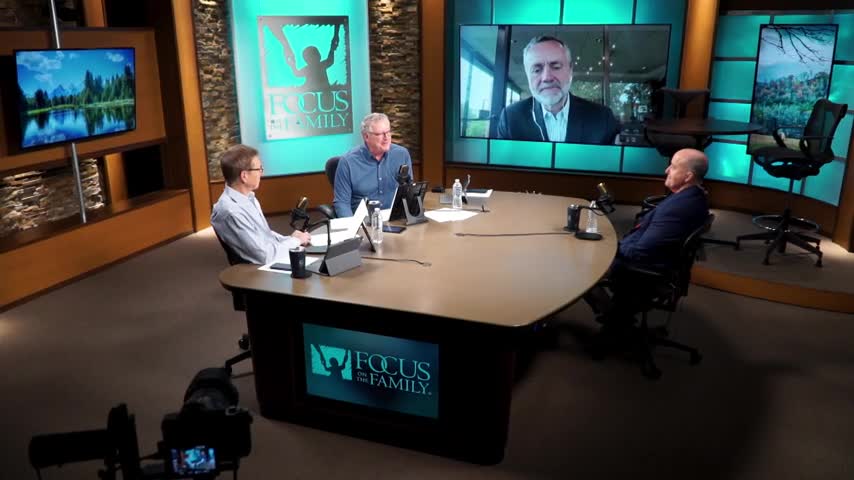
John Fuller: That's Dr. Larry Taylor joining us today on Focus on the Family with Jim Daly for what will be an insightful, encouraging show about standing strong in Christ in school. And today we'll have some exciting news for you about a federal tax credit that allows you to support the school of your choice, even public schools, and provide scholarships for students. You'll hear more information about that later on and we'll have details about that tax credit on our website. Thanks for joining us. I'm John Fuller.
Jim Daly: John, I think every parent wants their child to grow up with a strong mind, a tender heart, and faith toward Christ. I mean, that's what we as Christian parents hope for with our parenting journey. And parents today are facing a lot of questions. There's a lot of challenges bombarding them as the social media situation, how much screen time—that's one of the biggest questions we get here at Focus on the Family. But what about their schooling? How is that going? What are the choices? Should I homeschool? Do I put them in a charter school, a private school, a Christian school? And then with colleges, where are they going to go? And what's the best value for the money? And, man, we're going to try to address some of those questions today to give you, the parent, information to allow you to talk it over and think about what are those choices and what are your goals and aspirations for your child.
John Fuller: Yeah, this is kind of a high-level look and we have two great guests with us here in the studio. Dr. Larry Taylor, who is President and CEO of the Association of Christian Schools International, and he previously led two Christian schools for many years. And then remotely from California, Dr. Barry Corey, the President of Biola University. And both of these men have decades of experience in education.
Jim Daly: Oh, they do. Dr. Taylor and Dr. Corey, welcome.
Dr. Larry Taylor: Thank you.
Dr. Barry Corey: Thank you. Good to be here.
Jim Daly: Yeah. Let me say our Vice President of Marriage, Greg Smalley, went to the Rosemead School of Psychology out there at Biola, which is your school there. At the college level, how difficult is that to maintain biblical truth with young people that are coming in with all kinds of different worldviews? I'm sure it's not monolithic. But how do you as a Christian educator keep that the core thing?
Dr. Barry Corey: Well, it has to be the core thing, right? There are too many stories of that central mission not being the core thing or being eroded along the way. Biola's 118 years old, so we've been doing this for a long time. And so when Dr. Smalley talks about his experience here, I get it. I see that from our 5,567 students. And I think they come to places like Biola, and there are many places, Biola is not the only one, that hold strongly to God's enduring truth that matters today. But we also want to do that in a way that we're giving students a kind of education that can prepare them for the world that's before them. But it's a daily discipline. We're always having the conversation: How are we staying faithful to our mission and how are we preparing our students for what they need?
Jim Daly: Yeah. It's so true and I think that's kind of the point. You want as a parent to make sure you're doing your research and where are those good schools. Now let's back up. You start with K through 12, Dr. Taylor, with ACSI. And you're working with how many schools do you work with at ACSI?
Dr. Larry Taylor: In the United States, about 2,300 schools, but around the world, close to 25,000 schools.
Jim Daly: I mean, that's amazing, the reach and the breadth of that. For both of you, and I'll start with you, Dr. Taylor, when you look at the culture, there are some big issues that are in the culture today. What concerns you most, especially with K through 12, and I'll come to you, Dr. Corey, in a moment. But K through 12, cultural inputs, what is making your job challenging today?
Dr. Larry Taylor: Well, it's exciting, especially here in the United States. Every day, 55 million kids are going somewhere to school.
Jim Daly: 55 million?
Dr. Larry Taylor: Yeah.
Jim Daly: I don't think we know that number. That's huge.
Dr. Larry Taylor: 50 to 60 million, depends on who you talk to, but around 55 million. And they're going, as you mentioned earlier, a variety of places. And I think the challenge before pastors, school leaders, parents, I would say the identity, just the identity crisis of being comfortable in how God wired them and created them in His image. And I think that's probably one of the greatest challenges today for anybody that's hanging around young people—it's just their identity. Who am I?
Jim Daly: You think about that. You have a child right now today, he's or she is a kindergarten student, first grader. Eventually, Barry, that child's coming your way, hopefully. They're going to go to college, that'd be a good thing. Now, college has kind of lost a little bit of its edge in terms of trades and other things and young people choosing not to invest a large amount of money into that education. So I guess for you, Dr. Corey, at Biola and representing Christian higher education, what are the things that keep you up at night?
Dr. Barry Corey: I think there's students are disrupted. There is an instability in our culture and for us it comes back to what is really enduring and lasting and we see that as God's truth in His word and His world. Students are distracted with so many devices and temptations to lead them in this direction or that direction. I think students are disillusioned in many ways, and I see that in kind of coming here and wondering how do we live Christianly in a world where it's so hard. And I think students can come here with some distortions on the way God intended things to be with sex and sexuality and marriage and life and what justice is and what does it mean to live a life that's counter-cultural. And so we inherit these 18-year-olds and our responsibility is to take them to the next level of their faith and form them in a way that they're ready for when they leave Biola.
Jim Daly: Yeah. Larry, let me ask you, when you are looking at families and that educational choice, ACSI of course is going to promote a Christian education. Sometimes parents are looking for protection—we want our kids to be in a safe environment, a Christian school hopefully would be able to supply that. The reality is that's not always true. Kids are kids no matter where kids are. And you're going to have some bullying issues, you're going to have other issues. But why should parents look strongly, if they can afford it, which is a whole other issue, why should they look at Christian education as a very favorable way to go?
Dr. Larry Taylor: Great question. You know, I think when we look at God's word, it's very clear that parents are assigned the important task of spiritual formation—Psalm 78, Deuteronomy 6. And formation is messy. You're exactly right, Jim. Christian schools are not perfect. Formation is messy. The opportunity as a parent checking out a Christian school, the opportunity to mentor ambassadors and not activists. A fine line there. So if I'm a parent looking at a Christian school, I'm looking carefully in how are they forming, what is their intentional plan? Is it complementing what we're trying to do at home? Complementing what we're doing at church? But just dropping a kid off at any Christian school, I don't recommend.
Jim Daly: Well, and I want to challenge that too, because I think we as parents, and I think I did this to a degree, that we're going to put the boys in a good school and that has a faith orientation. It was a charter school started by Christians. But I think I expected, okay, they're going to do a lot of that job. And I did what I could, but I'm just warning the parent, you've got to be, it's like your medical situation. You've got to be your advocate. And I think for your children's education, you need to be their advocate. Don't just put them in the system and let them run down the conveyor belt to Barry at the college level, right? But in that regard, again, the choice is there. There are a lot of good Christian educators in public schools. I want to make sure we say that. One of them helped lead me to Christ when I was in high school—my football coach. So they are there and they need that recognition as well. But again, that's something, wow, am I going to be able to trust that? And I would say as a parent, if there are better ways that you could go, look at those choices, correct?
Dr. Larry Taylor: Absolutely. I often think of the word congruent, congruency. Any place—church, school, baseball, doesn't matter—any place that's going to have one second of my child's brain that day, are they congruent with the message of God's word, the message that we, being the parents, are trying to instill in our home? But I think at the end of the day, the most important thing that a parent can do in selecting who's going to spend time with my child's brain and heart is are they—I like how Acts chapter 19 talks about the school of Tyrannus when Paul took 12 men for a long time every day to the school of Tyrannus. And of course, these men were the ones who took the gospel to the world. But they beat up ideas. Is that Christian school going to be a school of Tyrannus? Are they going to take on life issues, whether it's in the humanities, math, science, whatever? Are they going to form my child's mind and heart to whatever God's assignment is for that child? And we know God has an assignment for every child. Is that school going to be a school of Tyrannus prepared for anything that my child is going to encounter for the rest of their life?
Jim Daly: Wow, that is really good. That is really good. This is Focus on the Family with Jim Daly and our guests today are Dr. Larry Taylor, President and CEO of the Association of Christian Schools International, and Dr. Barry Corey, the President of Biola University. Obviously, this is a high-level look at the landscape of education from kindergarten all the way through college. We have so much for you at our website to help out. We've got the Thriving Student podcast, we have articles, audio shows, videos. We have our Age and Stage newsletter. It's all there for you. And just stop by focusonthefamily.com/broadcast. You'll find all of these resources and so much more. Larry, let me pry a little bit more on performance in K through 12. We read again in news reports that test scores are falling. Different schools seem to perform slightly differently. It's hard to compare Catholic schools and Protestant schools and public schools and charter non-affiliated religious schools. When you look at that landscape, what seems to be working well in the methodology that we're seeing? Catholic schools tend to perform pretty well.
Dr. Larry Taylor: Yeah, I would encourage people to look at Cardus, C-A-R-D-U-S. Cardus Think Tank out of Canada, extensive research on exactly what you just asked. They're on their—it's a longitudinal research on comparing Catholic, Christian, homeschool, public, private, everything. And they study students 6 to 21 years after they've graduated. So it's, I think it's my go-to when I study what is working, what is not working. It's very clear, very objective. And it's encouraging. It's encouraging when we talk about Protestant, which is what mostly ACSI schools are, Protestant-based. One of the most important things as just a U.S. citizen—not getting into what's best private, public, whatever—is can kids read? Can kids—today, those 55 million kids that go to school, only one third—this is sad—only one third of those children in eighth grade are proficient in reading. So just as an American, when we think about our world, our culture, the future of the United States or wherever you live, we're talking about the basics—reading and math. And I think it's very clear how are the students performing on the objective testing. That's hugely important. Obviously, the discipleship of their heart and mind is cornerstone, that is number one top priority. But at the end of the day, if God really has an assignment for every child, and I believe that God does, that assignment could be that God wants them to be an engineer, a lawyer, a doctor, a pastor. And that means that their brain matters. And so performance in some of the basic fundamental educational segments is hugely important. As a disciple of Christ, it's important, but just as a citizen of this great country, it's important that these 55 million students are can compete with anybody in the world scholastically.
Jim Daly: Read and write and do arithmetic, those things. Barry, I want to ask you philosophically. The late Chuck Colson was a good friend of mine. We talked often about education. That was a passion that he had in addition to the prison ministry, Prison Fellowship, that he founded. But he made some comments that really got my attention, which is in underperforming schools in low-income neighborhoods, etc., that we're locking these children in to a life of poverty because they cannot access education that will help them to rise above their circumstances. And when you look at it that way, that we're in essence condemning a child born in a poor family in a poor neighborhood with poor performing schools, it's going to perpetuate poverty.
Dr. Barry Corey: Yeah. And thanks for bringing up Chuck Colson. And I think if Chuck was on your show talking about this, he would just say, "Hey, play the long game." It's going to take some generations to change this. But the students coming to Biola—and I use this distinction more and more—that students come here for what they want and discover here what they need. And so when I see students that are saying like, "Hey, I want to go into the inner city and make a sacrifice and go through either teaching those schools—charter schools, public schools, Christian schools—I think they're saying like, "I'm going to be part of the solution to those places that are often seen as less than." I might not make enough money, it might not be as prestigious on my resume, whatever it might be. But I just sense more and more that this generation is more interested in making a difference than they are in making a million.
Jim Daly: I think you're right. I do. The Gen Zers seem to have that passion. For the mom or dad listening to this, it can feel overwhelming, Larry. I got to do homework now. I've just had this baby, and now I've got to start thinking about their educational path. How do you suggest that they simplify this? Barry just got to it—kind of look at the long game. But what are those practical simplification ideas about educational choice?
Dr. Larry Taylor: Well, we have 6,570 days from the time a baby's born until a principal will hand them a diploma. So as a parent, to simplify, 6,570 days. Parents know their babies better than anybody. And I would encourage parents to just take a step back and to think through not the money initially—I mean we know it costs money—but to think through: I know my son, I know my daughter. What type of educational learning environment will they most likely thrive in? And of course, I'm biased, I'm going to encourage them to go to a Christ-centered option. But at the end of the day, there is so much information that parents can connect to as they are exploring the local options. But I want to encourage your listeners, I want to encourage all the moms and dads and the grandparents to take a step back, to commit it to prayer, seek counsel, and ask a lot of questions. Don't just think that because a school has Christian in their name, that they're all the way authentic.
Jim Daly: It's called being in a fallen world. Exactly. You could put church in there, you could put so many things in there because we're not perfect and that's just the way it is. Let me ask both of you this. Many parents may only feel they have one option and that's public school. So if you're in that position where you don't have the resources financially to do private school or Christian school, how do you make the best use of that time and how do you encourage them to stay engaged? I mean, you're both educators, so forget the difference between university and K through 12 for a minute. If you're just consulting or counseling parents of younger children, again, who have to be in public school, what would you say to them?
Dr. Barry Corey: Well, let me maybe approach it a little bit differently, Jim. And I would say when it comes to maybe public higher education, that is certainly an option and often seen as a less expensive option. But some practical advice that I would give to parents is that, one, remember that between the ages of 18 and 22, they're some of the most transformative years in a human being's life: relationally, intellectually, spiritually, interpersonally. So those are years to steward well. Second, at least apply to a Christian college. There are hundreds of them to look at, but at least apply to one. Three is look beyond the sticker price. I mean, sometimes they say, "Well, I can't afford that. Look at how expensive it is." Well, there's so much financial aid that's available. Financial aid counselors are going to work with you. So I would tell them to like, don't just eliminate a Christian college or university just because you look at how expensive it is or how far away it might be from your home. And then realize that faculty can form you more than you might think. And so what major you decide to choose in a public university or a university that doesn't have any kind of Christian background, I think will—get involved. Do the research. Know where those graduates go. Know what those faculty members teach and where they studied. I think that matters. Get involved in a kind of campus ministry. There's so many: Chi Alpha, Reformed University Fellowship, Navigators, Cru, on and on it goes, Intervarsity. I think that matters as well. And get involved in a local church.
Jim Daly: No, that's good. K through 12, Larry, getting more practical?
Related Episodes
Growing Your Relationship Through Every Season of Life – II
Wednesday, October 7
Growing Your Relationship Through Every Season of Life – I
Tuesday, October 6
Leaving Pro-Gay Theology for True Faith
Monday, October 5
Related Videos


About Focus on the Family
We want to help your family thrive! The Focus on the Family program offers real-life, Bible-based insights for everyday families. Help for marriage and parenting from families who are in the trenches with you. Focus on the Family is hosted by Jim Daly and John Fuller.About Jim Daly
Jim Daly
Jim Daly is President of Focus on the Family. His personal story from orphan to head of an international Christian organization dedicated to helping families thrive demonstrates — as he says — "that no matter how torn up the road has already been, or how pothole-infested it may look ahead, nothing — nothing — is impossible for God."
Daly is author of two books, Finding Home and Stronger. He is also a regular panelist for The Washington Post/Newsweek blog “On Faith.”
Keep up with Daly at www.JimDalyBlog.com.
John Fuller
John Fuller is vice president of Focus on the Family's Audio and New Media division, leading the team that creates and produces more than a dozen different audio programs.
John joined Focus on the Family in 1991 and began co-hosting the daily Focus on the Family radio program in 2001.
John also serves on the board of the National Religious Broadcasters.
Contact Focus on the Family with Jim Daly
Mailing Address
Focus on the Family
8605 Explorer Dr.
Colorado Springs, CO
80920-1051
Toll-free Number
(800) A-FAMILY (232-6459)


